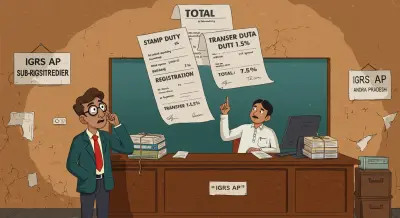


If you searched for your Vijayawada property on IGRS AP and selected “Krishna” as the district, you probably found nothing. That is not a portal error. Since April 2022, Vijayawada city is no longer in Krishna district. It is in NTR district.
This is the single most common reason NRI owners of Vijayawada property hit dead ends on the state’s records portals.
Vijayawada has a deep NRI property base. The city’s position at the Krishna river crossing and its role as the commercial hub of coastal Andhra made it a first destination for NRI investment from Telugu communities in the US, UK, Gulf, and Australia, well before the Amaravati capital announcement. That announcement, and the APCRDA zoning that followed, added a layer of administrative complexity that most property owners have not fully mapped.
This guide covers what is specific to Vijayawada and NTR/Krishna district. For the general AP property management framework including Meebhoomi, Section 22A blocked properties, pattadar passbooks, and PoA requirements, the AP NRI property guide covers all of that in detail. For stamp duty rates, guideline values, and the registration process, see the AP stamp duty guide.
The NTR district split: the thing to get right first
Andhra Pradesh bifurcated Krishna district on 4 April 2022. The old Krishna district was divided into:
- NTR district (headquarters: Vijayawada): covers Vijayawada city, Vijayawada Rural, Ibrahimpatnam, Nandigama, and surrounding mandals
- Krishna district (new, headquarters: Machilipatnam): covers Gannavaram, Penamaluru, Gudivada, Machilipatnam, and the coastal delta mandals
If your property is in Vijayawada city or its immediate suburbs, it is in NTR district.
On IGRS AP, select “NTR” as the district when searching for ECs, checking registered transactions, or looking up guideline values. Selecting “Krishna” returns records for Machilipatnam and the delta.
For properties with long transaction histories predating April 2022, older records may still appear under “Krishna” on IGRS. If your first search returns nothing, try both district names. The registered documents and SRO codes did not change; only the district navigation did.
SROs in NTR district: finding the right office
Vijayawada’s urban area is registered across two SROs:
- GUNADALA SRO (code 615): Vijayawada Urban, broadly the northern and central areas including the Veterinary Colony and Road No. 2 zones
- PATAMATA SRO (code 621): Vijayawada Urban, the southern and central areas including Patamata Nagar and the Central Bank Street corridor
For peri-urban and rural areas:
- NUNNA SRO (code 628): Vijayawada Rural
- IBRAHIMPATNAM SRO (code 616): Eastern suburbs and VTPS Road area
- VIJAYAWADA R.O. (code 627): The District Registrar’s office in Gandhi Nagar, handles district-level matters and appellate work
Broader NTR district: GANNAVARAM (614), NANDIGAMA (619), NUZVIDU (620), KANKIPADU (617), KANCHIKACHERLA (618), MYLAVARAM (625), and others cover the surrounding mandals.
The easiest way to confirm the correct SRO is the Know Your SRO tool at registration.ap.gov.in/igrs/findSRO. Enter the village name or ward number and it returns the SRO name, code, and address. Getting this wrong is why many EC searches return a blank Form 16 even when transactions exist - a blank EC is not a clean title, it is a wrong SRO.
EC for Vijayawada properties
Go to registration.ap.gov.in, select NTR district, choose your SRO, and search by document number, survey number, or house number. EC records are digitised from 1 January 1983.
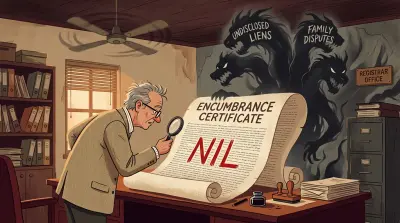
Form 15 is issued when registered transactions exist during the search period. It lists every sale, gift, lease, mortgage, and court attachment recorded with the SRO. Form 16 (nil EC) means no registered transactions in that period, not a clear title. Unregistered agreements, pending litigation, and tax arrears will not appear on either.
For the step-by-step IGRS AP EC search process, how to read each entry in Form 15, and what to do when the portal returns nothing, see the EC online guide for NRIs and the encumbrance certificate explainer.
How to check and pay property tax in Vijayawada
The VMC administers property tax for properties within city limits. The working portal is vijayawada.cdma.ap.gov.in. The older domain vmcvijayawada.gov.in has persistent connectivity issues; use the CDMA portal.
Checking dues:
- Go to
vijayawada.cdma.ap.gov.in - Select “Know Your Dues” under property tax services
- Search by one of four identifiers: assessment number, old assessment number, owner name, or door number
- The portal shows outstanding dues by financial year with any penalties
Paying online:
Once the property record appears, pay through the portal. The transaction generates an acknowledgement number. Keep it as proof of payment. NRIs paying from abroad can use the available online payment modes; retain both the acknowledgement and the bank transaction record.
Finding your assessment number: It appears on old property tax receipts and demand notices. If you do not have it, a door number search usually works for assessed properties.
Properties not yet assessed: This is common in areas absorbed into VMC limits through recent urban expansion. If your property was in a gram panchayat area that was later merged into VMC, it may not yet be in the assessment register. The CDMA portal has a “File Your Self Assessment” service for this. The form requires the zone, usage type, construction type, plinth area, floor number, and age of construction.
Post-purchase mutation: After buying a Vijayawada property, the property tax records need to be transferred to your name through the “File Your Mutation” service on the same portal. Without mutation, demand notices continue going to the previous owner and you have no formal record of dues in your name. This is a step many NRI buyers miss entirely.
VMC covers 64 wards. If your property is outside VMC limits but within the APCRDA area, property tax may be administered by the local municipality or gram panchayat rather than VMC directly.
Layout approvals and APCRDA: the risk layer most NRIs miss
Vijayawada’s growth over the past two decades has created a significant stock of properties in former panchayat areas now absorbed into the urban fabric. The approval status of layouts in these areas is a genuine title risk, and it is the one thing the EC will not tell you.
The approval hierarchy works like this:
- Within VMC limits: Layout and building approvals go through VMC, with the DTCP office providing technical input
- Outside VMC limits, within APCRDA area: APCRDA (AP Capital Region Development Authority) is the competent authority for layout approvals
- Previously in gram panchayat jurisdiction: Gram panchayat permissions are not equivalent to formal layout sanction from VGTM-UDA, APCRDA, or VMC
The mandals around Vijayawada that fall under APCRDA include Vijayawada Urban, Vijayawada Rural, Penamaluru, Ibrahimpatnam, and Gannavaram. For buyers in these areas, the question is: was this layout sanctioned by VGTM-UDA (valid until 2014), APCRDA (post-2014), or only a gram panchayat?
Gram panchayat-only properties face two compounding problems. They are ineligible for utility connections and building permissions under normal rules. And they can only be regularised under the AP Layout Regularisation Scheme 2020 if the original registered sale deed predates 31 August 2019. If the seller bought the plot after that date from an already-unapproved layout, regularisation is not available.
APCRDA itself went through an unstable period: dissolved in 2020 under the three-capitals policy, restored in 2021. For properties in the Amaravati capital zone specifically, this policy shift created complications around layout approvals and land pooling that are still being resolved. A 2025 Andhra Pradesh High Court case involving a plot in Tadigadapa (a western Vijayawada suburb) turned on whether a road had been validly gifted to the gram panchayat as part of a layout - road dedications and open space contributions in peripheral layouts remain actively contested.
A 2006 AP High Court judgment involving VGTM-UDA confirmed that zoning violations are enforceable with no grandfather protection for prior use: “community interest should prevail over individual right.” A commercial use in an area reclassified as residential under the General Development Plan cannot claim protection simply because it predates the reclassification. This applies equally to layout approvals in areas where zoning has changed since the original sanction.
What to check before buying in Vijayawada:
- Request the layout sanction order from VGTM-UDA or APCRDA. A gram panchayat permission letter is not a substitute
- Verify the approving authority on the APCRDA portal at
crda.ap.gov.inor with the DTCP office for Krishna/NTR district - For properties in recently expanded VMC wards, confirm whether VMC has assessed the property or it is still on panchayat tax rolls
- For any layout without formal sanction, check whether the registered sale deed predates 31 August 2019 (the LRS 2020 eligibility cutoff)
Title risks specific to Vijayawada
A 2024 AP High Court case involving a 3.16-acre property near Vijayawada illustrated a title chain risk that appears regularly in Krishna district: sale deeds built on Will-based succession where the Will itself is disputed. The court confirmed that writ jurisdiction does not extend to resolving private title disputes; the only remedy is a civil suit. The case also turned on an injunction in a partition suit: the court held that a Sub-Registrar is not obligated to refuse registration solely because of an injunction in another civil suit, provided the seller was not a party to that suit. Whether the buyer’s title holds against the partition claimants remains a civil law question requiring separate litigation.
For NRI buyers, the practical implication is this: an EC search on IGRS will show court decrees registered with the SRO. But an injunction in a pending civil suit that has not been registered with the SRO will not appear. A litigation search at the City Civil Court, Vijayawada is the only way to catch those before you transact.
The broader systemic picture of property disputes and how they compound over time is covered in the India property dispute crisis post.
Related Reading
- Managing property in Andhra Pradesh: NRI guide - Meebhoomi, Section 22A blocked properties, PoA requirements, and the full AP records framework
- How to get an encumbrance certificate online - step-by-step IGRS AP EC search, what Form 15 shows, and what to do when the portal returns nothing
- Stamp duty and registration in Andhra Pradesh - guideline values, stamp duty rates, e-stamp payment, and the registration process for AP
- What an encumbrance certificate tells you (and what it misses) - the limits of EC-based title verification and what else to check before any transaction
Assetly covers Andhra Pradesh properties including Vijayawada. Upload your sale deed, EC, pattadar passbook, and property tax receipts and track document gaps and renewal deadlines from anywhere. Learn more at assetlyhq.com.