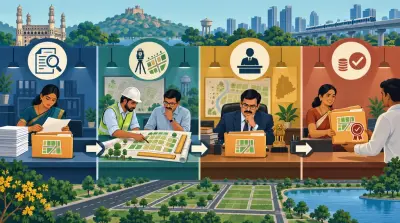


If you filed a Telangana LRS application in 2020, it is probably still sitting exactly where you left it.
We wanted to know how many people are in that position. So we read the published status of every application we could reach: 9,87,554 of them, across 122 municipalities in 30 districts.
Six years on, 15 percent are approved.
Now here is the part we did not expect.
The single biggest reason these files are stuck is not a government desk. It is a bill that was raised and never paid.
More than five lakh applications are sitting at a status that means, in plain terms, “waiting for you”. The municipality did the maths, put a number on the screen, and nothing happened after that.
So this is not really a story about a slow scheme. It is a story about half a million people who do not know their file is waiting on them, and what it takes to get each kind of stuck file moving again.
First, what LRS actually is
Telangana’s Layout Regularisation Scheme opened in 2020 under G.O. Ms. No. 131, dated 31 August 2020.
The idea was simple. Plenty of plots in the state sit in layouts that were never approved by the local authority. If you owned one, you paid ₹1,000, filed online, and waited for the municipality to work out what regularising it would cost. Pay that charge, clear scrutiny, and the layout problem against your plot goes away.
That is the theory. Here is where all 9,87,554 applications actually are:
| Stage | Applications | Share |
|---|---|---|
| Pending at Citizen | 5,76,382 | 58.4% |
| Pending at L1 (scrutiny) | 2,10,142 | 21.3% |
| Approved | 1,51,320 | 15.3% |
| Rejected | 19,896 | 2.0% |
| Pending at L2 | 17,952 | 1.8% |
| Closed or revoked | 8,465 | 0.9% |
| Pending at L3 | 1,808 | 0.2% |
| Under G.O. 111 | 1,019 | 0.1% |
| Pending at L4 | 38 | 0.0% |
One application in seven has actually been approved. Everything else is in a queue of some kind.
And the top row is more than half the scheme.
The largest queue is not a government queue
“Pending at Citizen” means what it sounds like. The file is not with a town planning officer or a revenue official. It is with the applicant.
Nearly six lakh applications are in that state, and the record tells us why in 90.6 percent of them:
| Fee status | Applications |
|---|---|
| Fee intimated, not paid | 5,22,059 |
| Fee paid | 2,49,890 |
| Fee not intimated (FTL / prohibited) | 1,23,801 |
| Fee not intimated (IGRS queue) | 56,379 |
| Fee not intimated | 25,651 |
| Fee not intimated (BPS) | 8,407 |
| Revised fee intimated | 949 |
| Fee paid, refund issued | 418 |
5,22,059 applications have been told what they owe and have not paid it. That is 52.9 percent of every application in the dataset. The municipality did its arithmetic, put a number on the screen, and the file has sat there since.
We cannot see what those people were asked to pay, because the portal only exposes the charge sheet once payment goes through. But we can see what the ones who did pay were charged. The median assessed bill was ₹34,223. A quarter were under ₹20,907 and a quarter were over ₹61,197.
If the unpaid half looks anything like the paid half, the amount sitting uncollected in this half-million-file queue runs well past ₹1,500 crore. That is an estimate built on the paid population, and the two groups may differ in ways we cannot measure, so treat it as an order of magnitude rather than a figure.
So why does nobody pay?
They do. They just need a deadline.
On 31 March 2025, 19,687 people paid their LRS charges. In the three days ending that date, 44,206 did. In the whole of the previous month, 982 did.
That was the day a 25 percent rebate expired, and ₹472 crore of the ₹745 crore ever collected in these municipalities came in during that single month. Six years of a scheme, and most of the money arrived in one four-week rush.
Hold on to that, because there is another rebate running right now.
What is not an estimate is what has already moved. Across the 2,47,827 applications with a payment receipt:
- ₹745 crore recorded as paid
- ₹220 crore waived under the 25 percent rebate
- ₹262 crore still showing as an outstanding balance
- Total charges assessed on those files: ₹1,451 crore
Paying works. Mostly.
This is the finding we did not expect to be so clean.
Split everyone who has ever made a payment into two groups: those who cleared the full assessed amount, and those who paid part of it and left a balance.
| Paid in full | Balance outstanding | |
|---|---|---|
| Applications | 1,71,745 | 76,082 |
| Approved | 68.2% | 42.0% |
| Still with officials | 18.2% | 34.2% |
| Back with the citizen | 12.6% | 22.3% |
Clear the full amount and roughly two in three applications are approved. Leave a balance and it drops to two in five.
We are not claiming the payment causes the approval. Files that are clean enough to be fully priced are probably also files that are clean enough to clear scrutiny. But the practical reading holds either way: a part-payment is not a half-approval. It is a file that stopped moving.
And roughly 75,000 applications are in exactly that position, carrying ₹262 crore in balances between them. Oddly, 31,535 of those are marked approved and still show a pending amount, so approval and a cleared account are not the same thing in this record either.
One thing the size of the bill does not predict is the outcome. We banded every priced application by plot size:
| Plot size | Median charge | Approved |
|---|---|---|
| Up to 100 sq yd | ₹15,131 | 43.0% |
| 101 to 200 sq yd | ₹28,605 | 49.0% |
| 201 to 300 sq yd | ₹45,104 | 49.9% |
| 301 to 500 sq yd | ₹73,985 | 48.4% |
| Over 500 sq yd | ₹1,85,002 | 46.7% |
The charge scales with the plot. The approval rate does not move. Whatever is blocking these files, it is not the size of the cheque.
The queue nobody can pay their way out of
Now the group that cannot do anything about it.
1,23,801 applications carry the status “Fee Not Intimated (FTL/Prohibitted)”. FTL is full tank level, the boundary of a water body. The tag also covers plots recorded as falling in a buffer zone or a prohibited category.
Every single one of them sits at L1 scrutiny.
Not one is approved. Not one is rejected. No fee has ever been intimated, which means there is no payment that would move the file. It has been in that state for six years.
That is by far the largest single blocker inside the official queue. Break the L1 stage down and it dominates everything else:
| What the L1 file is waiting on | Applications |
|---|---|
| Prohibited / FTL plot process | 1,26,318 |
| Normal plot scrutiny | 56,546 |
| IGRS queue | 12,449 |
| Reverted in phase 2 | 7,290 |
| Shortfall raised | 4,013 |
| Layout (not individual plot) application | 2,932 |
| Saved but never sent onward | 594 |
The portal also records which desks a file is sitting on. L1 field verification is done by a three-person team, and the codes are the departments on it: IR is irrigation, RE is revenue, TP is town planning. 1,03,625 files are waiting on all three at once. Another 74,138 are with town planning alone. Our companion guide walks through what each level actually does and what moves a file on from it.
Where the prohibited flag piles up is not random:
| Municipality | District | Applications | Flagged FTL / prohibited |
|---|---|---|---|
| Shamshabad | Ranga Reddy | 7,999 | 63.2% |
| Ameenpur | Sangareddy | 12,505 | 41.8% |
| Narsampet | Warangal | 5,778 | 38.6% |
| Meerpet | Ranga Reddy | 3,403 | 31.6% |
| Korutla | Jagtial | 9,373 | 30.7% |
| Boduppal | Medchal Malkajgiri | 18,413 | 28.6% |
| Karimnagar | Karimnagar | 27,766 | 28.3% |
Shamshabad, Ameenpur, Meerpet, Boduppal. These are the growth-ring names in the plot advertisements. In Shamshabad, nearly two applications in three are flagged.
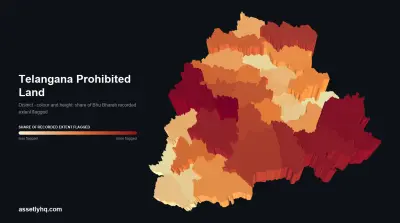
That pattern will look familiar if you have read our measurement of Telangana’s prohibited land register, where the same peri-urban belt carries the densest concentration of Section 22A flags. Two separate registers, built for different purposes, pointing at the same ring of land around Hyderabad.
We should be careful here. A flag is not a finding. It can reflect a genuine restriction, a boundary that needs survey, or an entry that covers a whole survey number when only part of it is affected. Our data records the tag and not the reason behind it.
The district picture
Approval rates vary more than you would expect for a single state scheme run on a single portal.
| District | Applications | Approved | Fee intimated, unpaid | Collected |
|---|---|---|---|---|
| Ranga Reddy | 1,30,961 | 14.0% | 46.4% | ₹155.6 cr |
| Medchal Malkajgiri | 66,631 | 20.2% | 37.7% | ₹135.9 cr |
| Nalgonda | 65,078 | 14.8% | 59.1% | ₹27.9 cr |
| Siddipet | 60,236 | 10.6% | 65.9% | ₹17.1 cr |
| Nizamabad | 55,276 | 18.4% | 55.4% | ₹46.9 cr |
| Wanaparthy | 49,409 | 13.7% | 68.3% | ₹11.7 cr |
| Suryapet | 49,393 | 15.4% | 68.0% | ₹34.7 cr |
| Jagtial | 26,673 | 8.6% | 60.4% | ₹13.0 cr |
| Khammam | 16,813 | 24.9% | 56.1% | ₹22.1 cr |
| Medak | 13,100 | 25.9% | 53.1% | ₹11.8 cr |
Medak and Khammam clear a quarter of their files. Jagtial clears fewer than one in eleven.
Ranga Reddy and Medchal Malkajgiri together account for ₹291 crore of the ₹745 crore collected, which is 39 percent of the money from 20 percent of the applications. Land near the city is worth more, so the charge on it is higher.
Look at the unpaid column and a different split appears. In the outlying districts, two-thirds of applicants have a bill they have not paid. Around Hyderabad, that figure sits in the thirties, not because more people paid, but because more of those files never got priced at all. They are stuck behind a prohibited flag instead.
Two ways of being stuck. Same six years.
What “stuck” means at each stage, and what actually moves it
Here is the practical version, stage by stage.
Pending at Citizen, fee intimated, not paid. The file is waiting on you and nothing else. Log in, check the intimated amount, and decide. This is the one stage in the entire scheme where the applicant is fully in control. Right now the 25 percent rebate is live until 30 November 2026, extended from a window that had been due to close on 31 July 2026. The March 2025 pattern suggests most people will wait until the last fortnight, which is also when the portal is slowest.
Pending at Citizen, fee already paid. There are 37,939 of these. Around 16,455 have an outstanding balance, so the remaining instalment is the blocker. Another 21,001 paid in full and are still sitting there, which means the authority has asked for something: a document, a clarification, a shortfall. That notice may have gone to a mobile number or email from 2020. Log in and read the file rather than assuming a paid receipt is the end of it.
Pending at L1, normal scrutiny. Genuinely with officials, across up to three desks. There is no citizen action that skips it. What you can do is make sure nothing is missing on your side, since a file that gets reverted for a shortfall goes back to the bottom of a queue. The published support routes are the LRS helpline on 1800 425 8838 and support-lrs@telangana.gov.in, plus the webchat and WhatsApp options in the Reach Us section of the portal.
Pending at L1, prohibited or FTL flag. No fee will be intimated and no payment will help. If the flag is wrong, the correction happens outside the LRS portal entirely, through the revenue and irrigation records that put the plot inside the boundary in the first place. Our guide to checking FTL and buffer zones before buying in Hyderabad covers how those boundaries are drawn and where to verify them. If the flag is right, LRS was never going to regularise the plot, and six years of waiting has been telling you that quietly.
Pending at L2 or L3. These are the review and final approval layers above L1, and only 19,760 applications have reached them. Getting here is good news. Of everyone who paid in full, more sit at approved than at every pending stage combined.
Rejected. Just under 20,000, and most never got to the fee stage at all: 16,702 rejections carry “fee not intimated”. Around 2,850 paid first and were rejected after. A refund route exists, with 418 applications carrying a refund-issued status, but the data does not tell us what qualifies.
Closed, revoked, or under G.O. 111. Small buckets. Of the 8,465 closed or revoked files, 8,407 are tagged BPS, the separate building penalisation scheme, so they were routed elsewhere rather than decided. The 1,019 under G.O. 111 relate to the old catchment restriction around the Osman Sagar and Himayat Sagar reservoirs.
What the receipt actually says
Worth quoting, because it is printed on every acknowledgement the portal generates and almost nobody reads it:
“The receipt of Layout Regularisation (LR) charges is subject to approval of LR application and final computation of LR charges. This receipt does not give any right for Regularisation.”
The government wrote that on the document itself in 2020. The data now shows what it means in practice: 98,785 applications have paid ₹237 crore between them and are not approved.
If you are buying a plot and the seller produces an LRS receipt, that receipt proves a payment reached an application. It does not prove the layout is regularised. Our guide on what an LRS receipt proves and what approval actually needs goes through the document-by-document version of this.
One more thing in the data
Applications are not evenly spread across people.
Of the mobile numbers in the dataset, 323 are attached to 33,489 applications. Another 4,430 numbers carry between 11 and 50 each. Roughly 60 percent of all applications come from a number that filed more than once.
Some of that is families filing for several plots. A lot of it is agents and developers filing in bulk on behalf of buyers.
Which raises a question worth asking if you bought a plot in an unapproved layout around 2020: is there an LRS application in your name that somebody else filed, on a mobile number that is not yours? If the fee intimation went to that number, you would have no way of knowing. That is a meaningful share of the half-million unpaid files.
What this data cannot tell you
It does not cover GHMC or HMDA. This is the municipal corporation and municipality dataset, 122 urban local bodies in 30 districts. Hyderabad district does not appear at all. HMDA runs its own much larger pool, and by the state’s own account in May 2026 it had received 2,90,369 applications and approved 33,096. If anything, the pattern there is sharper than what we measured.
It is a snapshot, taken between 17 and 21 August 2026. Statuses change. Anything you act on has to come from the live portal on the day.
It records the tag, not the reason. We can see that 1,23,801 files carry a prohibited flag. We cannot see whether each one is a genuine restriction, a survey issue or an error.
Charge figures cover paid files only. The portal exposes the computation after payment, so every rupee figure here describes the 25 percent of applications that paid, not the half that did not.
Some receipts did not reconcile. Total, initial payment, rebate, amount paid and pending balance add up exactly on 77 percent of receipts. We have used the paid, rebate and pending figures, which are individually consistent, rather than leaning on the assessed total.
So what should you actually do
If you have an LRS application in Telangana, the useful moves are narrow.
Find out which of the eight stages you are in. Not “it is pending”. The stage and the fee status together tell you whether the file is waiting on you, on an official, or on a flag that no payment will clear. If you do not have the application number, because an agent or a relative filed it, search by name.
If the fee is intimated and unpaid, this is your window. The rebate stands at 30 November 2026 as things currently stand. Do not plan on the last week.
If you paid in full and it is still at the citizen stage, go and read the notice. Twenty-one thousand people are in this position. Something was asked for and the answer never came back.
If you paid in part, understand what you have. A balance is not progress. It is a file at 42 percent odds instead of 68.
If you are behind a prohibited or FTL flag, stop waiting for the portal. Nothing will happen there. The question is whether the boundary is correctly recorded against your survey number, and that gets settled in the revenue and irrigation records.
Check the contact details on the application. If the mobile number belongs to an agent from 2020, every intimation the municipality has sent has gone to somebody else.
And do not treat approval as the end of it. Regularisation deals with the layout. It does not fix a title defect, clear an encumbrance, settle a boundary, or substitute for layout approval on the ground. Those are separate checks and they always were.
Six years is a long time for a file to sit still. For more than half of them, the thing holding it up is a payment nobody made and a notice nobody read.
Method
Everything here comes from the Government of Telangana’s own LRS records at lrs.telangana.gov.in, read as a single pass between 17 and 21 August 2026. The set covers 9,87,554 applications across 122 urban local bodies in 30 districts, all filed in 2020 under G.O. Ms. No. 131. Individual plots make up 9,83,105 of them and layout-owner applications 4,449.
Stage counts use the portal’s own status strings, grouped where the string encodes both a stage and a processing queue. Money figures are drawn from the 2,47,827 applications with a payment receipt, since the portal only publishes the computation after payment. Personal details in the source records are not reported here in any form.
Scheme context, including the ₹1,000 plot and ₹10,000 layout application fees and the wording printed on the receipt, comes from the state’s published LRS user guide. The rebate position reflects the extension to 30 November 2026 announced on 1 August 2026, and rebate terms change, so confirm on the portal.
Assetly helps property owners keep their documents and application trail in one place, and notice when the status against a property changes.