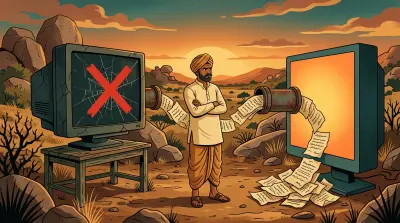


In January 2026, a routine check in Jangaon turned up a small accounting mismatch in a land registration. The amount paid into the government treasury did not match the amount recorded on the document. Officials pulled the thread. By the time the revenue department finished its first sweep, the mismatch had a number attached to it: roughly ₹48 crore, diverted out of Telangana’s land registration system across about 4,800 transactions.
That figure is almost certainly a floor, not a ceiling. The audit examined a slice of roughly 50 lakh transactions sitting on the state’s land records platforms, the old Dharani portal and the Bhu Bharati system that replaced it. Some estimates inside the revenue department put the eventual total in the hundreds of crores once the full audit is done.
For most property owners in Telangana and Andhra Pradesh, a scam about diverted government fees sounds like someone else’s problem. It is not. The way this fraud worked, and one specific thing the auditors found, says something uncomfortable about how much you can trust a land record you did not personally verify.
How the money left
The mechanics were almost boring, which is part of why they ran for so long.
Every land registration in Telangana generates an e-challan, the electronic payment instrument for the stamp duty and registration fee. The fraud lived inside that step. In the simplest version, two challans were generated for a single registration: a low-value challan that was actually paid to the government, and a higher-value challan whose amount was quietly routed into a private bank account.
In other cases the operators did not even bother with two challans. They reversed a payment after the challan had been generated, or simply altered the trailing digits of the figure. An amount of ₹1,50,000 was settled with ₹1,500. A ₹1,00,000 liability was cleared with ₹10,000. The document showed the full sum. The treasury received a sliver of it. The difference disappeared.
The work was outsourced to the edge of the system, where ordinary citizens actually touch it. In Yadadri Bhuvanagiri, investigators named an online service-centre operator, Basavaraj, who allegedly charged around ₹5,000 per transaction to “process” the e-challan payment for people registering their land. The citizen handed over the full fee, believed it had gone to the government, and walked away with a registered document that looked completely normal.
Rangareddy and Yadadri Bhuvanagiri came up as the worst-hit districts, with Jangaon, Medchal-Malkajgiri, Sangareddy and Mahbubnagar also flagged. These are not remote tehsils. They are the districts that ring Hyderabad, where land changes hands constantly and a single survey number can be worth a fortune.
The finding that should worry owners
If the story stopped at stolen fees, it would be a governance scandal and not much more. Your registration would still be valid even if the operator skimmed the fee, because the shortfall is the government’s loss to recover, not yours.
But the audit found a second pattern, and this is the one to sit with.
In some cases, a sale deed registration was shown as cancelled in the system, on payment of a ₹2,000 cancellation fee, while the original registration was allegedly left standing in practice. Read that twice. An entry that the public record says was undone was, on the ground, still treated as live. The two versions of reality did not match, and someone with access to the system decided which one each audience would see.
That is no longer a fee problem. That is record tampering, the precise mechanism behind most long-running property disputes in this country. A title fight rarely starts with a forged signature in front of you. It starts years earlier, with an entry that was quietly added, removed or contradicted in a register you never thought to check. We have written before about how small errors in land records snowball into decades of litigation; this is what the first link in that chain looks like when it is deliberate rather than accidental.
The investigation is now examining whether the diversions were possible only because staff inside the Centralised Citizen Services system colluded, whether the software itself was exploited, and whether plain negligence left the door open. The revenue secretary alerted district collectors, the National Informatics Centre was brought in on the technical side, and the Telangana Lokayukta has sought a report from the government. None of those answers will be quick.
What this actually means for your property
Be precise about the risk, because panic helps no one.
If you bought or inherited property in Telangana and the registration genuinely happened, your title is not voided because some operator stole the fee. The state will chase the operator and the shortfall. Your deed stands on its own legal footing.
The real exposure is narrower and more specific. It matters if any of these are true for you:
- You registered a transaction through a third-party service centre or middleman and never independently confirmed it landed correctly in the record.
- Your property sits in one of the hotspot districts around Hyderabad, where the volume of manipulated entries was highest.
- You own land you have not personally checked in years, especially agricultural land on Dharani or Bhu Bharati, and you would not hear through the local grapevine if an entry changed.
That last category is where remote owners and NRIs are genuinely more exposed than anyone else. A resident who lives on the land would eventually hear that something odd was filed against it. Someone managing property from Bengaluru, Dubai or New Jersey finds out at the worst possible moment: when they try to sell, mortgage or transfer it, and a buyer’s lawyer surfaces a cancellation or a competing entry nobody mentioned.
What to do this month
None of the protective steps here are exotic. They are the same checks a careful buyer’s lawyer runs, applied to property you already own.
Pull a fresh encumbrance certificate. Go to registration.telangana.gov.in and pull the EC for your property covering the years around your registration and everything since. Confirm your transaction is there, that the consideration and survey number match your sale deed, and that no cancellation or later competing entry has appeared against it. Our guide to getting an EC online walks through the portal step by step.
Cross-check the Record of Rights. For agricultural land, open bhubharati.telangana.gov.in and confirm the ROR shows you as the holder with the correct extent and survey number. If the entry is wrong, the process for correcting a Bhu Bharati record is worth starting now rather than later, because corrections only get harder as records settle into finality.
Find your challan and receipt. Dig out the original registration receipt and the e-challan from when you registered. If the fee was diverted, the document the operator gave you is your evidence that you paid in full and in good faith. If you cannot find it, the Sub-Registrar Office holds a copy.
Stop trusting the operator’s word. If you registered anything through a service centre and took their confirmation at face value, verify it yourself on the portal. The whole scam depended on that gap between “they told me it was done” and “I checked that it was done.”
Check what your power of attorney actually allows. Many NRIs hold a POA that covers selling but not the more mundane work of inspecting and correcting revenue records. If yours is silent on that, a fresh special power of attorney is cheap insurance.
For the underlying discipline of confirming a title chain from the parent document forward, our property title verification guide covers the full sequence, and the Dharani to Bhu Bharati transition explainer covers what migrated and what may have broken along the way.
The wider point
Telangana built one of India’s most digitised land systems, and that is genuinely a step forward from the paper registers that vanished, burned or got rewritten by whoever held the pen. But digitisation moves the point of failure rather than removing it. The forger who once needed access to a physical register now needs access to a login. The ₹48 crore did not leak because the system was paper. It leaked because the people and software guarding the digital system had gaps, and a handful of operators found them.
The lesson for an owner is not to distrust the portal. It is to stop treating the portal as something that watches itself. A land record is only as reliable as the last time someone who cares about it actually looked. For property you live on, that happens by accident. For property you own from a distance, it only happens if you build the habit.
Assetly is a property document management platform for Indian property owners and NRIs. Keep your sale deeds, encumbrance certificates, registration receipts and revenue records in one secure vault you can check from anywhere, so an unexpected change in the record does not stay hidden until you try to sell. Learn more at assetlyhq.com.