

A 93-year-old retired government official moved to the United States to live with his children after his career ended. He owned a 14-cent plot and a two-storey house in Pettah, Thiruvananthapuram. At some point, he decided to sell it.
He listed the property online. He was approached by a man named Rajendra Rao.
Over the next two years, the two corresponded regularly. Rao was patient and methodical. He built rapport, kept in touch, earned the old man’s trust. When they finally agreed on a price - ₹3.43 crore - it seemed like a straightforward transaction.
The cheque bounced. Or had signature issues. The exact mechanism of the payment failure is still being investigated. But the property sale was already in motion, a KSFE official had allegedly been involved in legitimising some aspect of the transaction, and the complainant - a 93-year-old man halfway across the world - had been defrauded of his life’s property.
Thiruvananthapuram police registered a case in March 2026 against Rao, the KSFE official, and a vendor named Manikantan. The case is under investigation.
No court has yet ruled on the BN Silva case. But the pattern it represents has been ruled on before.
The Pattern the Courts Have Seen
In 2008, two brothers residing in Bahrain authorised their brother in Kerala to handle legal matters on their behalf. During a visit home, they signed blank stamp papers expecting routine use. The attorney holder - their own brother - took those blank papers and executed three registered sale deeds, transferring the brothers’ properties to his close relatives.
The buyers paid ₹15 lakhs via cheque. The market value of the properties was considerably higher. No one verified the transaction with the actual owners in Bahrain. No one checked whether the principals had authorised these specific sales. The documents looked correct. The registrations went through.
The Kerala High Court, in B.M. Rafi & Another v. Basheer M. Picha & Another, eventually voided all three sale deeds. Justice Devan Ramachandran described the situation plainly:
“The whole transaction between them…was a mere complot for the latter to grab the plaint schedule properties.”
The court found that the buyers had not conducted basic due diligence, that the consideration paid was grossly inadequate, and that the entire transaction was structured to defraud. Even registered documents, the court confirmed, are void when fraud is proven.
The properties were recovered. But the journey from fraud to recovery took years of litigation.
Why Selling From Abroad Is a Specific Vulnerability
When you live in India and sell your property, the entire transaction happens in your presence. You meet the buyer. You confirm the payment has cleared. You are at the registration office when the deed is signed. You can walk away if anything feels wrong.
When you are in California, London, or Dubai and selling property in Thiruvananthapuram, none of this applies. You cannot meet the buyer. You receive payment into an account and cannot stand at a bank counter to verify it in real time. You are not at the registration office - you have authorised someone else to be there. Every step of the process depends on trusting people you cannot directly oversee.
This gap is what fraudsters exploit. And the BN Silva case shows how sophisticated the exploitation can be. Two years of correspondence to build trust is not an impulsive crime. It is a calculated investment with a specific target in mind. Elderly NRIs who own property and have no family in India to manage it are among the most targeted profiles in Indian property fraud.
The Documents That Failed
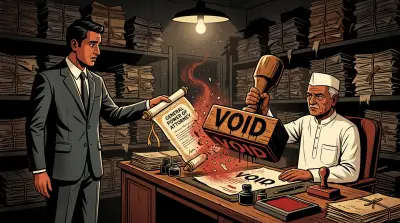
In the B.M. Rafi case, the document failure was structural. Blank signed stamp papers are not a document safeguard - they are a loaded weapon handed to whoever holds them. The moment you sign blank stamp papers, you have authorised whatever the holder chooses to fill in. Courts treat documents bearing your genuine signature as evidence of your agreement, which means proving the fraud requires overcoming your own signature.
In the BN Silva case, the document failure appears to have been a payment instrument. A personal cheque from a buyer you vetted only through online correspondence provides essentially no security. Cheques can be returned unpaid. A personal cheque from an unknown buyer is, at best, a promissory note - a statement of intent, not a guarantee of funds.
Both cases illustrate the same principle: physical distance from the transaction forces the NRI to rely on documents in place of presence. When those documents are flawed - blank papers, unverified cheques, PoA holders with unchecked authority - the fraud becomes inevitable.
How Legitimate Buyers Are Different
This bears saying because the fear of fraud should not prevent NRIs from selling property. Fraud-free property sales happen every day. But legitimate buyers behave differently from fraudsters.
A genuine buyer does not spend two years building trust before proposing a transaction. They conduct due diligence - they hire a lawyer to verify title, check the encumbrance certificate, confirm mutation records. They are often in a hurry to close, not to prolong the correspondence.
A genuine buyer also pays through a secure instrument. Demand drafts, RTGS transfers confirmed in advance, or escrow arrangements are the standard for high-value property transactions. A buyer who insists on a personal cheque for a multi-crore property transaction is a red flag.
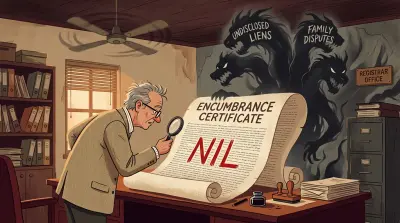
The encumbrance certificate is one of the first things a legitimate buyer requests. It shows the transaction history of the property, any encumbrances or liens, and provides a chain of title. If a buyer is not interested in the EC, they are not doing proper due diligence - or they are not a legitimate buyer.
What Protects You
Use a demand draft or RTGS, not a cheque. For any significant property sale, insist on a demand draft issued by a bank, or RTGS transfer with confirmation from your bank that the funds have cleared before you proceed. The token advance, agreement to sell, and final sale deed should each be tied to verified, cleared payments.
Verify the buyer’s identity through independent channels. Online introductions require additional verification. Have your local lawyer conduct a background check on any buyer introduced through a listing website or online correspondence. A legitimate buyer will expect this.
Limit your PoA. If you must authorise someone to execute the sale on your behalf, use a limited PoA that specifies the exact property, the minimum acceptable sale price, and the conditions of the transaction. A general PoA is an open door. For more on how NRI PoA misuse happens, see our detailed guide to protecting yourself from PoA fraud.
Never sign blank papers. The B.M. Rafi case should serve as a permanent warning: signed blank stamp papers are not a convenience, they are a liability. Any document you sign should be fully completed before you put your signature on it.
Get an EC before the transaction, not after. An encumbrance certificate from the previous 15 to 30 years will show whether the property has any existing encumbrances, loans against it, or prior unregistered claims. You should have this ready before the buyer does.
Maintain mutation records in your name. A gap between the registered owner and the person shown in mutation records is a vulnerability. Before you sell, verify that mutation is current in your name. If it is not, correct it first. Discrepancies give fraudsters room to manoeuvre.
Confirm registration personally, even from abroad. Modern registration systems in several states now send SMS or email confirmation when a document is registered. Enroll for these notifications so that if any document is registered in your name without your knowledge, you are alerted.
Kerala has one of the largest Gulf NRI populations in India. The risks of managing property in Kerala from abroad are specific and well-documented - and they extend through the sale process, not just the period of ownership. The broader pattern of property disputes across India consistently shows that absence is the single biggest risk factor. Every safeguard above is designed to compensate for what physical presence would otherwise provide.
What Happens When a Registered Sale Deed Is Challenged
The B.M. Rafi case confirms something important: a registered sale deed is not the end of the story when fraud is involved. Registration creates a presumption of validity, not proof of legitimacy.
Under Section 19 of the Indian Contract Act, any agreement where consent was obtained through fraud - as defined in Section 17 - is voidable at the option of the party whose consent was so caused. This includes registered sale deeds. But establishing fraud in court requires evidence - which is why the document record before and during the transaction matters so much. Evidence of the PoA’s scope, the consideration agreed, the payment instruments used, and the communications between the parties all become relevant in litigation.
Winning is possible. In B.M. Rafi, the properties were recovered. But it took years. BN Silva is 93. He should not have to spend years fighting to recover property he was defrauded of in his nineties.
The documents are not just bureaucratic formality. They are what makes recovery possible when things go wrong - and what makes fraud impossible when they are done right.
Assetly is a property document management platform that helps NRI property owners organise, verify, and track all their property documents from abroad. Learn more at assetlyhq.com.