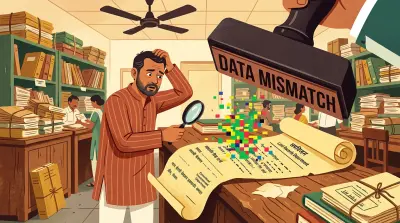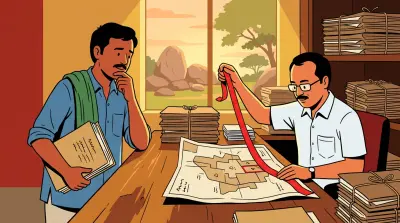
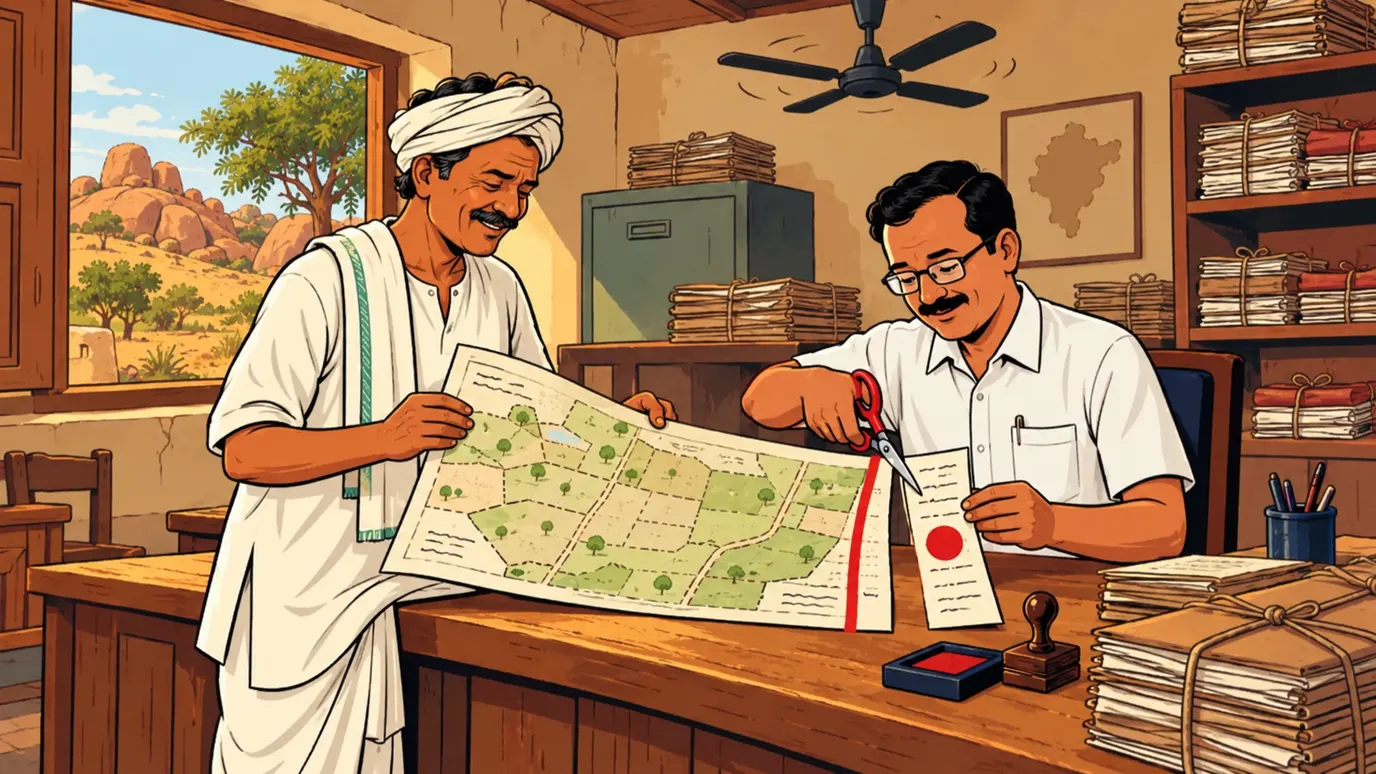

A road, canal, reservoir or public project takes a strip from a larger agricultural parcel. The acquisition order says the government acquired 10 guntas. The remaining land still belongs to the pattadar.
But Bhu Bharati shows the entire survey number as acquired.
That one data error can freeze far more land than the government actually took. The owner may be unable to transact with the remaining property or obtain a correct pattadar passbook. A buyer sees a government-acquisition problem. A bank sees an uncertain parcel. The family sees land in its possession but a digital record that treats the balance as if it no longer exists.
Telangana has now published a specific Bhu Bharati remedy for this situation. The official notice says the new functionality is for cases where only a small extent was acquired but the entire survey number was categorised as acquired by mistake. This guide explains what that remedy addresses, which documents matter and what to verify after the Collector decides the application.
First Confirm That This Is the Exact Error
This route is narrow. Use it only when all three statements are true:
- The government completed or recorded an acquisition affecting land in your survey number.
- The acquisition covered only part of that survey number.
- Bhu Bharati treats the whole survey number, rather than the acquired portion, as acquired.
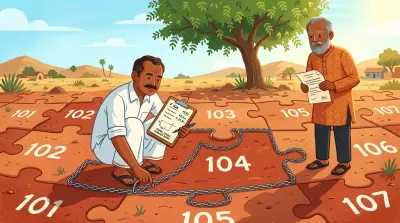
Imagine Survey No. 148 measures 2 acres. A road-widening proceeding acquired 10 guntas along one edge. The record should distinguish the acquired strip from the 1 acre 30 guntas left with the pattadar. If the portal instead blocks or categorises all 2 acres as acquired, that is the problem this grievance is designed to correct.
The figures in that example are illustrative. Your application must use the extent and boundaries in the actual acquisition proceedings.
Start with the official Bhu Bharati Land Details Search. Save the result showing the district, mandal, village, survey or subdivision number, pattadar, PPB, total extent and transaction status. Compare it against the acquisition papers and the latest physical survey records.
If the portal has the wrong name, ordinary extent error, missing subdivision or incorrect land classification without a partial acquisition, start with the broader guide to checking and correcting Bhu Bharati land-record errors. Choosing the route that matches the error is important because each application asks the authority to decide a different fact.
This Is Not Automatically a Section 22A Case
An acquired-land flag and a prohibited-property entry can produce the same practical result: registration stops. They are not necessarily the same legal problem.
The acquired-land grievance asks a factual question: How much of this survey number did the government acquire? The official correction process then separates that extent from the balance.
A Section 22A problem asks why a property has been placed in a prohibited category and whether the legal basis for that restriction is correct. Government ownership, assigned land, endowment land, ceiling-surplus land, court restraint and notified prohibitions can require different evidence and authorities.
Check the displayed reason rather than guessing from the fact that a transaction failed. If the record is in a prohibited register, use the category-specific Telangana 22A grievance guide. If it explicitly reflects an acquisition that swallowed the entire survey number, continue with the acquired-land route.
The Acquisition Proceedings Are the Decisive Record
The official Bhu Bharati notice says the pattadar must provide:
- Pattadar Passbook details
- The survey number in which the acquisition occurred
- The actual extent acquired
- The land-acquisition proceedings showing the pattadar’s name, survey number and extent
That last document is the centre of the case. The authority needs an official record that answers three linked questions: whose land was acquired, from which survey number and for how much area.
A registered sale deed may prove how the family acquired the larger parcel. An Encumbrance Certificate may show registered dealings. A property-tax receipt may show payments. None of those documents, by itself, proves the final extent taken in a government acquisition.
Build a clean file around the acquisition proceedings:
- The final award, acquisition proceeding or other operative order recording the acquired extent
- The pattadar’s current and earlier PPB details
- The registered deed and link document that describe the parent parcel
- Current Bhu Bharati land-details result
- Pahani or Record of Rights extracts from before and after the acquisition
- FMB, village map, subdivision sketch or survey record showing where the acquired strip lies
- Compensation or possession record, if it helps connect the proceeding to the land
- Identity and contact details matching the pattadar or authorised applicant
Do not upload an unsorted bundle and expect the official to reconstruct it. Put a one-page comparison first:
| Record | Survey number | Total extent | Acquired extent | Balance claimed |
|---|---|---|---|---|
| Acquisition proceeding | As recorded | Parent extent | Exact acquired area | Calculated balance |
| Current Bhu Bharati entry | As displayed | As displayed | Extent treated as acquired | Extent remaining in PPB |
| Survey or subdivision record | As mapped | Measured extent | Acquired strip | Remaining parcel |
Use the actual local units from the records and have the arithmetic checked. An acre contains 40 guntas, but a correct total does not cure a boundary mismatch. The map and the numbers must describe the same ground.
How the Bhu Bharati Decision Works
The public notice describes the following departmental path:
- The pattadar applies with the PPB, survey-number and actual-acquired-extent details.
- The acquisition proceeding showing the name, survey number and extent is uploaded.
- The application goes to the District Collector.
- The Collector examines the record and passes an order stating the correct acquired extent.
- The Collector enters the details, uploads the order and approves or rejects the application.
- The pattadar receives an SMS after the decision.
Bhu Bharati does not state on that public notice that every application will be approved or promise one universal disposal time. The proceeding still has to establish that the current entry is wrong. Boundary ambiguity, inconsistent extents, a later acquisition or a dispute over the parent parcel can require further verification.
Keep the application number, acknowledgement and every document exactly as filed. Use the portal’s application-status service to check the record rather than relying only on an intermediary’s update.
Survey Splitting Is the Core of the Remedy
Approval does more than change a label. The official explanation says the correct extent will be shown as acquired and the balance land will appear in the pattadar’s passbook with survey splitting.
That distinction matters. A parent survey number can no longer safely describe two legal realities as one undivided record: a part held by or acquired for the government project, and a part that remains patta land. The corrected record needs to separate them so the portal can treat each extent appropriately.
After approval, verify:
- The acquired subdivision and its extent
- The balance subdivision and its extent
- The pattadar name and khata attached to the balance
- Whether the balance is available in Land Details Search
- Whether the transaction status applies only to the acquired portion
- Whether the sketch or parcel record matches the new split
For the practical difference between a parcel map and a textual revenue entry, read FMB Sketch and LP: Your Land’s Official Treasure Map. A corrected number is useful only if it can be connected to the physical parcel.
What Happens to the Pattadar Passbook?
The notice says an electronic PPB is issued after approval and the pattadar receives an SMS with a download link. It also draws an important distinction between the electronic and physical versions.
The ePPB reflects the corrected balance after survey splitting. If the owner also wants a printed physical passbook, Bhu Bharati says a separate application must be made through the Duplicate PPB module.
Do not assume that a physical book will arrive automatically. Download and preserve the ePPB, then compare its PPB number, khata, survey or subdivision, extent and owner details against the approval order. The guide to Telangana pattadar passbook numbers and common errors explains what the PPB identifies and what it does not prove by itself.
If the Collector Rejects the Application
Obtain the order and read the reason. A rejection because the proceeding does not identify the pattadar is different from a rejection because the claimed balance conflicts with the survey record. Do not respond to both with the same generic representation.
Check whether the order says:
- The acquisition covered the whole parcel
- The claimed extent does not match the official proceeding
- The survey or subdivision cannot be identified
- The applicant is not the recorded pattadar or authorised person
- Another proceeding, dispute or prohibition affects the land
- A required record was missing or unreadable
The next step depends on that reason. It may involve obtaining a certified acquisition record, correcting the applicant’s revenue identity, commissioning or requesting an official survey, or using the appeal route under the Bhu Bharati framework. The broader Bhu Bharati appeal and Land Tribunal guide explains the escalation ladder, but the appeal should address the finding in the rejection order rather than repeat the original application unchanged.
If Approval Is Not Reflected Online
An approved order and an implemented digital correction are two separate milestones.
Save the order, SMS and application-status result. Re-run Land Details Search and download the ePPB. If the parent survey still appears wholly acquired, or the balance subdivision is missing, ask the revenue office for written confirmation that the Collector’s order has been implemented in Bhu Bharati.
Do not proceed with a sale merely because someone says the backend has been corrected. A buyer, bank and Sub-Registrar will rely on the live records available to them. Confirm the survey split and the status of the balance before accepting a token or signing a time-bound agreement.
A Practical Owner Checklist
Before filing:
- Save the current Bhu Bharati record
- Obtain the acquisition proceeding, preferably a certified copy
- Confirm the acquired extent, parent extent and calculated balance
- Match the pattadar name and survey number across the proceeding and PPB
- Collect the survey or subdivision map connecting the figures to the ground
- Separate this error from a 22A, court-case or ordinary classification problem
After filing:
- Preserve the acknowledgement and application number
- Track the application on the official portal
- Obtain the Collector’s uploaded order
- Check the acquired and balance subdivisions independently
- Download the corrected ePPB
- Apply separately for a physical PPB if needed
- Verify the live transaction status before selling, gifting or mortgaging the balance
The mistake may begin as one overbroad database entry, but its solution depends on precision. The acquisition proceeding must identify the exact land taken. The survey split must preserve the exact land left. And the corrected passbook must reflect that balance before the owner can safely rely on it.
Related Reading
- Your Telangana Land Records May Have Errors. Here’s How to Check and Correct Them
- Your Property Is on Telangana’s 22A List. What Can You Do Next?
- Pattadar Passbook Number in Telangana: Search, Meaning and Errors
- FMB Sketch and LP: Your Land’s Official Treasure Map
Assetly helps Indian property owners organise, verify and track their property documents digitally. This guide is general information, not legal advice. Learn more.