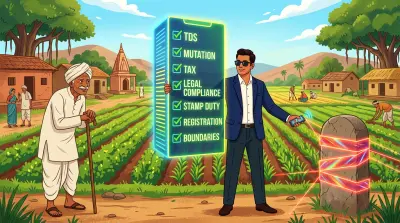


Many NRIs plan to return to India eventually. For some it is a permanent move after decades abroad. For others it is a long sabbatical, a parent’s illness, or a three-month stay to settle affairs. Either way, the property you own in India does not wait for you to arrive. Tax dues accumulate, records drift out of date, and the Power of Attorney you granted years ago keeps working whether you still want it to or not.
The good news is that most of what needs sorting can be started from abroad, weeks before you board the flight. The mistake returning NRIs make is treating the property as something to deal with “once I’m settled in”. By then you are managing a household move, school admissions, and a dozen other things, and a missed tax deadline or an unredesignated bank account becomes one more fire to fight.
This is a checklist organised by timeline: what to do from abroad, what to do in your first week on the ground, and the legal and financial transitions that follow. Work through the parts that apply to your situation.
Before you fly: do these from abroad
These items need no physical presence. Start them four to six weeks out so anything that surfaces has time to be resolved.
Clear outstanding property tax
Pull up your municipal portal and check the current dues against every property you own. Property tax arrears attract penalty interest, typically 1% to 2% per month depending on the city, and they compound quietly while you are away. Pay off anything outstanding now, and keep the receipt. A clean tax record is also the first thing you will want in hand if you decide to sell or transfer the property later.
Pull a fresh encumbrance certificate
An encumbrance certificate shows the registered transactions against your property: sales, mortgages, court attachments, and liens. Download a current EC covering at least the period since you last checked. The point is to confirm that nothing has been registered against your property without your knowledge, which is a real risk for absentee owners. One limit to keep in mind: an EC only reflects documents that were actually registered at the Sub-Registrar, so it will not show an unregistered or oral mortgage, a short lease, or litigation that was never registered. Treat a clean EC as necessary but not the whole picture. If the EC shows an entry you do not recognise, you want to discover it now, with months to investigate, not on a frantic visit to the Sub-Registrar after you land.
Confirm your mutation records are complete
Mutation is the update of municipal and revenue records to reflect you as the current owner for tax purposes. It does not by itself prove legal title, the registered deed does that, but it is what links the property to your name in the tax and revenue system. It is the step NRIs most often leave half-finished, especially after an inheritance or a purchase made remotely. If mutation was never completed, the property may still be recorded in a previous owner’s or a deceased relative’s name, which creates problems the moment you try to pay tax, sell, or transfer. Verify online or through your representative that mutation is done and the records carry your name correctly.
Decide what happens to your Power of Attorney
If you granted a Power of Attorney so someone could manage your property while you were overseas, ask a simple question: once you are in India to act for yourself, does that authority still need to exist? A broad PoA left active after you return is pure downside. The holder retains the legal power to deal with your property even though you no longer need them to. Plan to revoke it formally at the Sub-Registrar, narrow it to specific tasks, or at minimum review its scope. Do not leave it running by default.
Your first week in India
Once you land, a few things are worth doing in person early, while you still have the energy and before the move swallows your time.
Verify records at the Sub-Registrar
Visit the Sub-Registrar’s office for the area where your property sits and confirm that the records held there match what you saw online. Online portals are reliable but not infallible, and a physical verification of the index and the encumbrance position gives you certainty. Carry your title deed and identity documents.
Settle anything at the property tax office
If your online check flagged dues, a discrepancy in the assessed area, or an outdated owner name, the municipal office is where you fix it. This is also the moment to update your contact details on record, your current Indian phone number and address, so future notices and demands actually reach you rather than an address you left years ago.
Inspect the boundaries yourself
Walk the property. For land and independent plots especially, a physical boundary inspection is the only way to catch encroachment, an informal passage a neighbour has started using, or a boundary wall that has quietly moved. Photograph the boundaries with dates. Absentee ownership is precisely the condition under which encroachment takes root, and the first physical visit after a long absence is when problems tend to come to light.
The legal review
Returning to India is a natural checkpoint for the legal side of your estate, because your circumstances have changed even if the property has not.
Review your will and succession plan
If your will was drafted abroad, confirm it is valid and enforceable for your Indian immovable property, or have a separate India will prepared specifically for your Indian assets. Your residential status, the spread of your assets, and your intentions may all look different now than when you last wrote it. Review inherited property, self-acquired property, and anything held jointly so the plan reflects your present situation. Succession left vague is the single largest source of family property disputes in India, and it is far cheaper to fix while you are present and well than to leave for your heirs to litigate.
The financial transition
This is where returning NRIs make the most expensive mistakes, because the changes are not optional and the timing matters.
Redesignate your bank accounts
Under FEMA, the day you return to India intending to stay, you become a resident. Your status does not wait for a fixed number of days to pass. That means your NRE and NRO accounts must be redesignated as resident accounts, and you should inform your bank promptly rather than letting them run as they are. NRE fixed deposits can usually continue to maturity at the contracted rate before conversion, so you need not break them early. Many returning NRIs also open a Resident Foreign Currency (RFC) account, which lets you continue holding foreign currency in India, useful if you still have overseas income, pensions, or assets you are not ready to convert. Property income such as rent should flow into your resident accounts once the change is made. The deeper FEMA framework, and what it permits, is covered in our FEMA rules for NRI property owners guide.
Understand your RNOR window before you act
This is the most valuable thing on the list and the most overlooked. When you return after years abroad, you usually do not become an ordinary resident immediately. For two to three financial years you are likely to qualify as RNOR, Resident but Not Ordinarily Resident.
What that means in practice: during the RNOR period, your foreign income is generally not taxed in India, while your Indian income is. The main exception is foreign income from a business controlled in, or a profession set up in, India, which stays taxable even as an RNOR. It is a one-time window, and it closes. If you are planning to sell foreign assets, repatriate funds, restructure overseas investments, or draw down foreign accounts, doing so while you are RNOR can be markedly more tax-efficient than waiting until you are an ordinary resident and your worldwide income becomes fully taxable here.
Your exact status turns on your day counts over the preceding years, so confirm it with a CA who handles returning-NRI taxation before you make any large move. The cost of that conversation is trivial against the tax you can save by sequencing decisions correctly.
If you plan to sell, sort your TDS position
If part of the reason you are returning is to sell a property, your residential status directly changes how the sale is taxed at source. A sale by a resident and a sale by an NRI attract very different TDS treatment, and the buyer’s obligations differ accordingly. Establish what your status will be on the likely sale date, so the buyer deducts and deposits TDS correctly. Getting this wrong is a common and costly error, and the consequences (mismatched credits, TRACES notices) land on both parties. Settle the timing and the paperwork before you list.
Your Assetly pre-check before you leave
Before you board, run a check on every property you own so you arrive knowing exactly where each one stands rather than discovering problems on the ground. The items worth confirming are the same ones above: current tax position, a clean encumbrance certificate, mutation complete and in your name, and your document set complete and accessible.
Assetly is built for exactly this. It keeps your property documents, tax receipts, and compliance records in one place, runs the verifiable items against government records, and gives you a clear picture of what is settled and what needs attention, all before you leave. For a returning NRI juggling a move across continents, that is the difference between arriving in control and arriving to a backlog.
Run your property check with Assetly, free for the first property, at assetlyhq.com/free-tools.