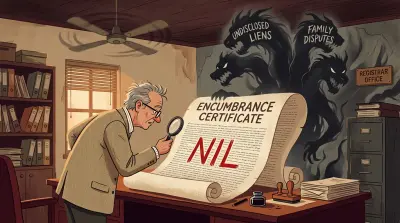


When a resident Indian buys property, they can visit the site, speak to neighbours, walk the Sub-Registrar office, and physically verify documents over days or weeks. As an NRI, you are doing most of this from abroad, over calls, through intermediaries who have a financial interest in the deal closing.
That asymmetry makes due diligence not just advisable but essential. These are the 20 things to verify before any payment beyond a nominal booking amount.
The 20-Point NRI Property Buying Checklist
1. Title chain (last 30 years)
Request all link documents showing how the property passed from owner to owner over at least three decades. Every transfer, whether by sale, gift, inheritance, or partition, should have a registered document. Unregistered transfers are common in older inherited properties and create title defects that surface at resale, during mortgage applications, or in succession. If any link is missing, do not proceed without a lawyer’s formal opinion on how the gap can be addressed.
2. Encumbrance certificate
The encumbrance certificate is the official extract of every registered transaction against the property for a specified period. Obtain one covering at least 30 years from your state’s IGRS portal: registration.telangana.gov.in for Telangana, registration.ap.gov.in for Andhra Pradesh, kaveri.karnataka.gov.in for Karnataka, tnreginet.gov.in for Tamil Nadu. Any undischarged mortgage, court attachment, or unexplained transaction must be fully traced and resolved before you sign.
3. Link documents (original title deeds)
Link documents are the physical originals of every registered document in the title chain: sale deeds, gift deeds, partition deeds, probate orders. Verify the seller holds the originals, not just certified copies. Missing originals often indicate an undisclosed equitable mortgage, where the borrower deposited title documents with a lender as security without registering the transaction. This type of mortgage leaves no public record and will not appear on the EC; it surfaces only when the originals are absent.
4. Mutation records
Registration with the Sub-Registrar and mutation in the revenue department’s land records are two separate processes; many buyers complete one and never do the other. Check whether the seller’s name appears correctly in the state land records portal: Bhu Bharati for Telangana (bhubharati.telangana.gov.in), Meebhoomi for AP, Bhoomi for Karnataka, MahaBhumi for Maharashtra. A seller whose name is absent from the records has a title that may be difficult to defend in any dispute.
5. Patta status
A Patta (or Pattadar Passbook in Telangana and AP) is the revenue document identifying the registered landowner in government records. For plots and independent houses, the Patta should be in the seller’s name. Verify that the survey number, extent, and owner name in the Patta match the sale deed exactly. Discrepancies between Patta records and registration documents require a formal correction process and can block mutation in your name after purchase.
6. Survey number verification
Confirm the survey number on the sale deed matches the actual physical location you are buying. Cross-reference with the state land records portal and, where available, the cadastral survey map. Mismatches can indicate that a different plot is being sold under the same documents, that a sub-division was never formally recorded, or that the survey number was subsequently revised following a re-survey. A physical inspection with the FMB (Field Measurement Book) sketch is the most reliable way to confirm.
7. Layout approval
Any plotted development must have layout approval from the relevant authority: HMDA or DTCP in Telangana, BDA in Bangalore, PMRDA or MCGM in Maharashtra. Request a certified copy of the layout approval and confirm that the specific plot you are buying falls within the approved area and matches the plan. Unapproved layouts are widespread in peri-urban and fast-growing corridors. Buildings on unapproved layouts cannot obtain an OC, and such plots are vulnerable to demolition notices.
8. RERA registration
For any new or under-construction project, verify RERA registration on your state’s portal: TGRERA (rera.telangana.gov.in), RERA Karnataka (rera.karnataka.gov.in), MahaRERA (maharera.mahaonline.gov.in), or TN-RERA (rera.tn.gov.in). Confirm that the registration is current, the project is not in a delayed status beyond permissible extensions, and the specific unit you are purchasing is listed in the registration. Buying in an unregistered project removes almost all the buyer protections that RERA provides.
9. Occupancy certificate and completion certificate
The Occupancy Certificate (OC) confirms the building was constructed in accordance with the approved plan. The Completion Certificate (CC) confirms construction is finished. Buying in a building without an OC means no legal right to occupy, difficulty obtaining utility connections, complications during home loan applications, and serious problems at resale. If the developer says the OC is pending, verify the project’s current status on the RERA portal and do not release the final payment tranche until the certificate is in hand.
10. Approved building plan
Separate from layout approval, every building requires a plan approved by the local body: GHMC or HMDA in Hyderabad, BDA or BBMP in Bangalore, BMC in Mumbai. Request a copy of the sanctioned plan and compare it against the actual structure. Unauthorised additional floors, enclosures, or structural alterations are common and attract demolition notices. In Hyderabad, both GHMC and HYDRAA have issued notices for unauthorised construction, including on properties owned by NRIs who were unaware of modifications made after their last visit.
11. Water and drainage approvals
Verify the property has a valid water supply sanction and is connected to the municipal sewerage system. For new buildings, the water board NOC is a prerequisite for the OC. For older properties, ask to see utility connection documents and confirm no outstanding dues with the water board. Properties reliant on borewells or septic tanks in areas covered by a municipal network may face problems obtaining or maintaining official connections after the sale.
12. Property tax clearance
Outstanding property tax dues transfer to the new owner at registration, not to the date of the arrear. You inherit all unpaid taxes the moment the sale deed is executed. Request property tax receipts for at least the last three years and verify nil arrears on the municipal portal: GHMC (ghmc.gov.in) for Hyderabad, the BBMP portal for Bangalore, or the relevant city portal. Include a clause in the sale agreement requiring the seller to clear all outstanding dues before the registration date.
13. Encroachment check
Confirm the property’s physical boundaries match the title documents and that no part of it sits on government land, a water body buffer zone, a road widening reserve, or a stormwater drain. Commission a physical inspection with the FMB sketch in hand. In Hyderabad, HYDRAA has been demolishing structures built on FTL (Full Tank Level) and buffer zone land, and NRI property owners have had limited recourse once the notice is issued. An encroachment that looks minor at purchase can make the property unsaleable or subject to demolition later.
14. Market value versus circle rate
The circle rate (guidance value in Karnataka, ready reckoner rate in Maharashtra) is the government-set minimum stamp duty value for a locality. If the seller is pricing significantly below the circle rate, investigate the reason before proceeding. If the transaction involves an undeclared cash component, you face income tax exposure: under Section 56(2)(x) of the Income Tax Act, the difference between the circle rate and the declared sale price can be treated as deemed income in the buyer’s hands.
15. Easement rights and right of way
Check whether any third party holds an easement over the property: a right of way across the plot, a right to draw water, or an informal passage that adjoining properties rely on. Easements are often not registered and will not appear on the EC. A physical inspection and conversations with neighbouring property owners are the most reliable way to surface them. An informal passage that others use routinely cannot be legally blocked after purchase, regardless of what your sale deed says.
16. FEMA compliance
NRIs may purchase residential and commercial property in India without prior RBI approval, but agricultural land, plantation property, and farmhouses are prohibited except by inheritance. Regardless of property type, payments must flow through authorised banking channels: NRE, NRO, or FCNR accounts, or inward remittance from abroad. FEMA violations carry penalties of up to three times the transaction value and are not resolved simply by paying the tax after the fact. Confirm payment routing before signing any agreement.
17. TDS on purchase from an NRI seller
If the seller is an NRI, you as buyer must use the non-resident withholding route under Section 393 of the Income-tax Act, 2025. Do not copy the 12.5% long-term capital-gains rate into the payment form without a transaction-specific computation: the withholding amount can depend on the taxable sum, surcharge, cess, the seller’s documents and any valid lower-deduction certificate. Since 1 October 2026, a resident individual or HUF buyer reports the transaction through Form 141 Schedule E without obtaining a TAN; other buyer categories should confirm the applicable TAN-based return. Verify the seller’s residential status before fixing payment terms.
18. Builder credibility (for new and under-construction property)
Check the developer’s track record on the RERA portal: look at previously completed projects for delivery timelines versus advertised timelines and any complaints or RERA orders on file. Search the NCLT portal for any insolvency proceedings against the company or its directors. A developer who is consistently late on current RERA commitments, or who has outstanding orders against them, is a reliable indicator of what your project experience will look like.
19. Society NOC (for resale flats)
For resale flats in a registered housing society, the society typically issues a No Objection Certificate confirming no dues or objections before registration proceeds. Request this from the society secretary along with a statement of outstanding maintenance dues, special levies, and sinking fund contributions. Maintenance arrears clear with possession, not with registration, meaning unpaid dues from the previous owner become your liability unless settled and documented before the handover date.
20. Loan NOC and mortgage discharge (if existing loan)
If the seller has an outstanding home loan, the lender holds the original title documents and a registered mortgage. The loan must be fully repaid and the mortgage formally discharged before or simultaneously with your purchase. Request the loan closure letter and verify that the mortgage satisfaction deed has been registered at the Sub-Registrar’s office. Without the registered discharge, you may complete your registration only to find that the original title documents remain with the lender.
Before You Pay a Rupee
Not every item applies to every transaction. A resale plot will not require an OC check; a new flat will not have a loan NOC to verify. Work through the items relevant to your deal, document what you find, and make any unresolved items explicit conditions in the sale agreement before you pay anything beyond a nominal booking amount.
Assetly’s free property check runs the core verifiable items against government records. Run your complete property check with Assetly, free for the first property, at assetlyhq.com/free-tools.