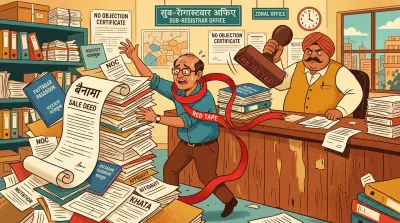


Your sale deed is registered. The seller has handed over the keys. A month later, the property-tax account still has their name, the electricity messages go to their phone, and the association sends you a bill addressed to someone else.
The purchase has reached an important milestone. The administrative handover may still be unfinished.
After buying a flat in Hyderabad, check each relevant account separately: the municipal property record, electricity connection, association account and any individual water connection. Keep the evidence of completion, not just the receipt showing that a request was made.
This is a post-purchase checklist for apartment owners, including those managing the flat from another city. It is not a second property-registration procedure. Official-source references were checked on 5 September 2026; municipal service arrangements can change, so establish the office responsible for your address from the current official record.
Registration and an account name change do different jobs
A registered acquisition deed belongs in your ownership file. A municipal mutation updates the relevant administrative record. An electricity title transfer changes the service account. Updating an apartment association’s records lets it administer membership, billing and communication under its rules.
These records should tell a consistent story, but they are not interchangeable.
In Jitendra Singh v. State of Madhya Pradesh, decided on 6 September 2021, the Supreme Court reiterated that mutation in revenue records:
“neither creates nor extinguishes title to the property”
That case concerned a disputed will and land-revenue entries, not Hyderabad’s flat-tax procedure. Its relevance here is the distinction between an administrative entry and adjudication of ownership. A name update cannot resolve a disputed title, and a stale entry alone cannot settle who owns the flat.
For the broader explanation, see property mutation, khata and patta. For this task, keep the question practical: which record should be updated, and what shows that the update happened?
Build a handover sheet for the flat
Copy identifiers from the documents themselves. Do not rely on a broker’s abbreviated address.
| Record | Identifier to retain | Evidence to save |
|---|---|---|
| Registered purchase | Document number, year and Sub-Registrar office | Complete deed, schedules and registration/payment records |
| Municipal property account | Property-tax identifier, address and responsible circle or office | Current assessment, receipts and applicable mutation order |
| Electricity | Service or consumer number from the actual bill | Current account details and name-change acknowledgement, where needed |
| Water | Individual consumer reference, or confirmation of a shared connection | Account details or association explanation of billing |
| Apartment association | Flat, block and internal account reference | Written acknowledgement of the ownership/contact update and account balance |
| Original documents | Document description and custodian | Handover list or lender’s custody acknowledgement |
Add the seller’s contact, the handover date and an owner for each unfinished task. Where two people buy jointly, record the legal ownership accurately and ask each service provider how its account will display the applicants. An account with space for one name should not be treated as evidence that the other co-owner has disappeared.
1. Check the registered document you actually received
Open the complete deed, including the schedules, endorsements and annexures. Compare the buyer names, flat and block, floor, property description and any stated land share with the transaction you agreed.
If the final document contains a substantive error, ask the drafting lawyer about the appropriate correction. Do not ask a municipal clerk to make a tax entry contradict the deed as a shortcut, and do not alter a scan to make it look right.
Keep a separate payment record and a list of originals. If your home-loan lender holds papers, obtain its document acknowledgement and retain legible copies for day-to-day use. The pre-sale document checklist is useful here too: these are the records you will eventually need to explain to your own buyer.
2. Find out whether municipal mutation is complete
Hyderabad’s municipal structure changed in February 2026. G.O.Ms.No.55, dated 11 February 2026, reorganised the CURE area into GHMC, Cyberabad Municipal Corporation and Malkajgiri Municipal Corporation. Identify which corporation now covers the flat before relying on a GHMC form, office or procedure. Shared service branding is not a jurisdiction certificate.
GHMC’s published mutation procedure describes a registration-linked process introduced in 2016. Registration information reaches the municipal office; an official processes the change; the competent officer approves it digitally; and an approved order becomes available.
That sequence explains an otherwise confusing situation. Your registration can have initiated the process while the municipal name change remains pending.
The document is a historical procedure, not a promise of today’s fee, interface or turnaround time. Use it to understand the distinction between initiation and approval. For an actual application or follow-up, confirm the current requirements with the responsible municipal service.
Start with the latest property-tax assessment and receipt. Identify the property number and office shown, then confirm the current corporation and circle handling it. The GHMC website remains an official reference, but an older receipt or a shared service using CURE or ghmc.gov.in branding does not establish that GHMC is the responsible corporation for your flat.
Ask for the mutation status or order for your transaction and compare the property identifier and recorded name. If you cannot retrieve a result online, request assistance from the responsible office using the deed and existing property reference. A failed search does not prove that no assessment or mutation exists.
3. Work out which kind of municipal problem you have
“My name is missing” can describe several different jobs.
The existing flat account still shows the seller. Check whether a mutation reference already exists, whether it is awaiting approval, and whether an objection or missing document has been communicated. Retain the response before deciding whether another application is necessary.
You have only a building-level record. Ask whether there is an individual assessment for the flat and what procedure applies if there is not. A first assessment or subdivision of an account may be a different task from changing the name on an existing account.
The name changed, but the property description is wrong. Compare the flat, block and account reference. Request a correction through the appropriate channel rather than treating the matching name as sufficient.
There is a genuine competing claim. Put the legal documents before a lawyer. An administrative service is not a substitute for resolving succession or ownership disputes.
In each case, obtain an acknowledgement with a reference number and a description of what has been requested. Before paying another fee, ask how any amount already collected with registration has been accounted for.
4. Reconcile property-tax payments separately
The name field and the payment balance answer different questions. Save the latest assessment or demand and the receipt, then compare the period covered and property identifier.
Ask the seller to identify any payment made around registration that has not appeared in the account. Keep the transaction reference. Check the sale agreement’s allocation of pre-handover and later dues rather than assume a name change settles the balance between you.
If the amount itself looks wrong, ask for the assessment basis and the applicable correction or objection route. Do not infer the correct tax from a neighbour’s bill: first establish whether the two accounts concern comparable properties and periods. Our property-tax guide explains the wider recordkeeping task.
5. Confirm the electricity account
Read the service number on the bill for the actual flat. Check the recorded consumer, contact details and payment status. If the ownership-linked update has already been processed, save the result; otherwise use the supplier’s current procedure.
TGSPDCL’s official downloads page lists a title-transfer application, document requirements, an indemnity-bond format and a consent format. Its published requirements distinguish situations such as joint ownership and inheritance. Download the current forms rather than copy a fee or stamp-paper amount from an old guide.
The word “title” here is the provider’s label for its service-account process. It does not mean the electricity company is conveying ownership of your apartment.
Also confirm access to future bills. A correct name with messages still going to the seller’s mobile is an unfinished practical handover. Follow the provider’s verification process for contact changes; do not depend indefinitely on the seller forwarding OTPs.
6. Establish how water and association billing work
Ask whether water is billed to the flat individually or through a shared building connection. For an individual account, use the supplier and consumer reference on the bill to enquire about the applicable change. For a shared connection, ask the association how the flat’s charges and owner contact are recorded.
Do not create an individual name-change task merely because a generic checklist says every apartment has one.
Give the association the ownership and contact documents its applicable rules require, and request written acknowledgement. Reconcile arrears, deposits and any agreed adjustments with the seller. Ask how parking use and access cards are recorded, retaining the underlying documents rather than relying on a security-desk entry.
Membership or account updates do not replace building papers. Keep access to the applicable occupancy and completion documents as part of the permanent property file.
Close the checklist with evidence
For each task, keep four things together: the request, the acknowledgement, any query or objection, and the final record. Mark it complete only when you have checked the relevant outcome.
For example, a mutation-fee receipt belongs under “submitted”. The approved order and updated account belong under “completed”. A forwarded message saying “done” is a prompt to retrieve the record.
If someone is handling the work on your behalf, give them this same sheet and ask for dated copies. Keep authorisations limited to the task and use the official service’s requirements. There is no need to hand over every family document for a routine contact update.
Finish by checking the first fresh bill or account statement after each change. The aim is simple: you should be able to identify the flat, explain who owns it, receive its notices and show which administrative updates have been completed, without calling the former owner for every document.
Related Reading
- Property mutation in India - how administrative records differ from legal title.
- Property-tax records and payments - keeping assessments and receipts organised.
- Documents needed to sell property - build the file your future buyer will need.
- Occupancy and completion certificates - the building papers to retain after moving in.
Assetly is a property document management platform for Indian property owners.